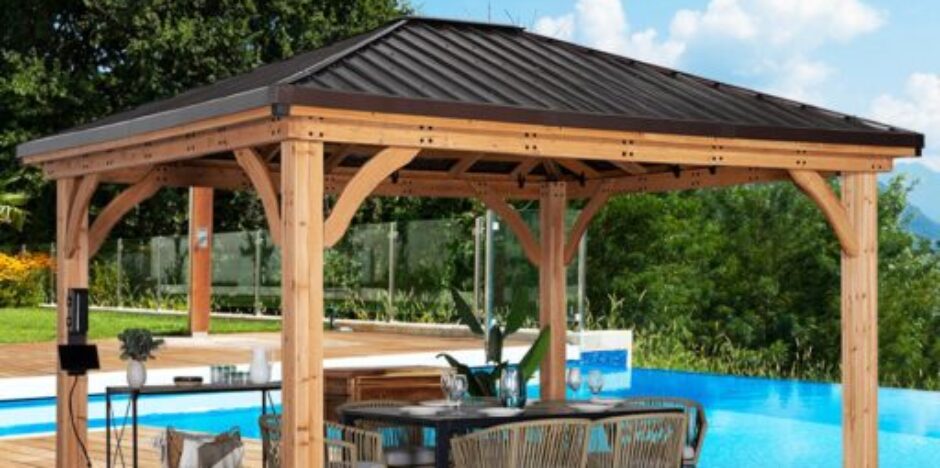
If you’re planning a metal roof for your backyard gazebo, these metal roof gazebo installation tips will save time and prevent common mistakes. In the first paragraphs, I’ll give you the core answers: choose the right gauge panels and fasteners, confirm roof pitch and underlayment, flash every joint, and reinforce rafters where panels overlap. For many homeowners a Backyard Discovery Barrington 12′ x 12′ Cedar Wood Outdoor Gazebo is a perfect candidate because its solid cedar rafters and clear spans make adding metal roofing straightforward.
One reassuring data point: a very similar Backyard Discovery gazebo was assembled in a single evening by two people — Preston and his brother — and that real-world build shows how organized pre-cut parts make gazebo installs achievable for non-contractors. Later in this article you’ll find the video and Preston’s article showing that exact experience.
Why pick the Backyard Discovery Barrington 12′ x 12′ for a metal roof
The Backyard Discovery Barrington 12′ x 12′ Cedar Wood Outdoor Gazebo has a sturdy post-and-rafter layout and a roof pitch suitable for metal panels (most homeowners choose a 3:12 pitch or higher for standing-seam or ribbed panels). Cedar rafters are durable and easy to reinforce with blocking or sistered lumber if you plan extra snow load protection. The Barrington family also comes in larger sizes if you need more coverage — 10×10 up to 24×12 — but the 12′ x 12′ is a balanced choice for patios and will accept metal roofing without major framing changes.

Pre-installation checks and planning
- Confirm roof pitch: metal panels work best at or above the manufacturer minimum (often 3:12). If your Barrington has a lower pitch, choose panel types rated for low slope.
- Measure panel runs: buy panels long enough for one run from ridge to eave to minimize seams.
- Inspect rafters and add blocking: sister a 2×6 to rafters or add blocking at panel seams to give screws a solid bite.
- Order the right fasteners: metal-to-wood screws with neoprene washers sized for panel ribs reduce leaks.
- Pick underlayment: synthetic roofing underlayment or a rubberized ice-and-water membrane under the panels improves leak resistance.
Step-by-step metal roof gazebo installation tips
These steps assume your gazebo frame (posts, rafters, ridge) is assembled and square.
- Dry-fit panels on the ground first to confirm length and trim points. Mark where overlapped ribs will meet rafters.
- Install a continuous ridge cap support: a small ridge board or cleat makes attaching the ridge cap easier and keeps panels tight at the peak.
- Lay underlayment from eave to ridge, securing with roofing staples. Overlap the runs by the recommended amount (usually 2–4 inches).
- Start at one eave and work across. Fasten the first panel at the eave and at every rafter intersection: two screws per rafter on flats or one in the rib depending on panel profile.
- Overlap subsequent panels per manufacturer instructions, seaming tightly and using closure foam at the eave to keep pests out.
- Install ridge cap and end flashing. Use high-quality butyl or polyurethane sealant at cut edges and flashing terminations.
- Trim and finish gable ends with metal or wood trim boards to keep the look consistent with cedar posts and rails.
Fastener placement and corrosion protection
Place fasteners at rafter lines and avoid over-tightening washers (they should compress, not flatten). Use stainless or coated fasteners rated for exterior use; if your gazebo is near salt air, choose stainless steel to avoid staining and corrosion.
Safety and teamwork
Metal panels are large and sharp — two people can handle them safely. Use a scaffold or a stable ladder system and a helper to hold panels while you fasten. Wear gloves and eye protection. The Barrington’s layout makes it practical for two people to finish roof panels in an afternoon once the frame is ready.
Watch a Real Backyard Discovery Gazebo Build in 4K
Before you commit to a gazebo, it helps to see one go together in the real world. Preston and his brother built a Backyard Discovery Arcadia 12′ x 9.5′ cedar gazebo in a single evening, start to finish.
In the 4K video below, you can see how the pre-cut, pre-drilled cedar pieces fit together, how the hardware is organized, and how manageable the process is for just two people. The fresh cedar smell, solid posts, and overall build quality are a big part of why we like Backyard Discovery so much.
If you want to see more photos and details from this exact build, Preston also wrote about the process on his personal site: PrestonShamblen.com/backyard-discovery-arcadia-gazebo-setup. It includes tips, notes, and behind-the-scenes details from the same evening.
Maintenance tips after installation
- Inspect screws annually and after storms; retighten any loose fasteners.
- Touch up exposed cut edges of metal with factory touch-up paint to prevent rust.
- Clear debris from eaves and check flashing seals at least once a year.
Conclusion: metal roof gazebo installation tips center on planning roof pitch, reinforcing rafters, using proper underlayment and fasteners, and sealing all flashings. The Backyard Discovery Barrington 12′ x 12′ is a strong, homeowner-friendly platform for metal roofing — and with two people you can reasonably complete the roofing phase in a single day once the frame is ready, as Preston’s build demonstrates.


